
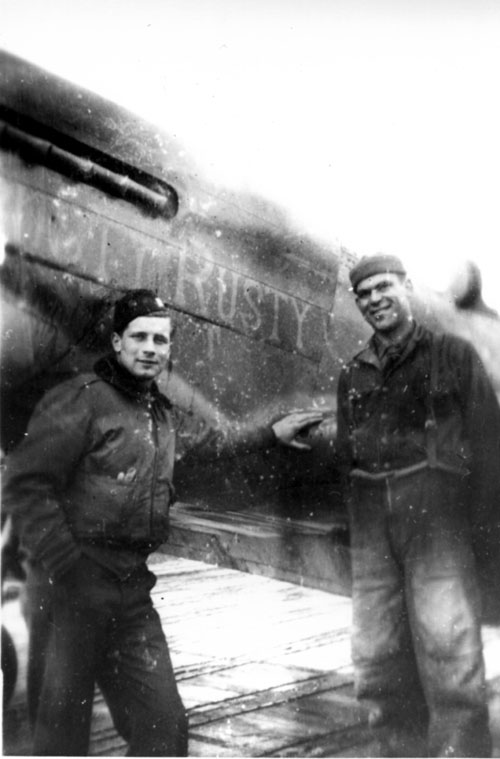
Captain Bob Winks (L) and Crew Chief with his Mustang “Trusty Rusty”
Interview with Captain Robert P. Winks, Ace, 364th FS, 357th FG
“On December 7, 1941, I was attending the University of Notre Dame, in South Bend, Indiana, as a freshman. I enlisted in the Army Air Force, but wasn’t called up until March, 1943. I rode a troop train from Indianapolis to the Cadet Center in San Antonio, Texas. In June, 1943, I attended Primary Flight Training, flying the PT-19 A and B, then Basic, flying the BT-13A. I attended Advanced Flight and Gunnery School in Eagle Pass, Texas, flying AT-6s, and finally received my Wings on January 6, 1944, Class 44A, with a total of 223 flight hours. I transitioned into P-40s (Allison engine) at Pinellas Air Force Base, Florida, and after a total of 80 hours training, was very, very cocky! It was to prove to be short lived! In May, 1944, I embarked on the Louie Pasteur in New York Harbor, and took off for England. We awakened the morning of 6 June, dead in the water, in the Irish Sea, off Liverpool, England. All Allied ships were ordered to stop where they were, because D-Day had arrived, and there were no Allied aircraft available to defend them. Sixteen hours in the P-51B (Merlin engine) at Goxhill, then on 9 July, I was assigned to the 357th Fighter Group, 364th Fighter Squadron. I had those sixteen hours flying a P-51B, in addition to 319 hours as a pilot. I was a typical replacement fighter pilot, in need of much on-the-job-training! I didn’t know that, but the 357th Fighter Group knew it, and they trained me, and I was lucky! The 357th FG was referred to by Lord Haw Haw as the ‘Yoxford Boys’ (Yoxford was a small road crossing about a mile away). He welcomed the 357th FG to England the day they arrived at their Leiston AFB, and he promised all of them, death!”
First Mission
“My first mission, July 18, 1944, was a Fighter Sweep into northern France at 15,000 feet, between Dunkerque and Calais. Have you ever heard of the Nazi Abbeville Kids? They were based near Amiens, and flew stretch-nose FW-190s, with yellow colored spinners and cowlings. The 8th Air Force knew them. They were good! I was flying on the wing of my Flight Leader, and we hit them head-on. The RT was alive and I looked away and looked back, and my Flight Leader was gone, and a yellow-nosed 190 was on my tail. I did what I had been told, and slammed my P-51 over into a tight flat left turn, held it tight while it vibrated and jumped, and finally snapped and spun down. I had 25 hours in a P-51, and I had no idea when it would snap and spin out, but I recovered and nervously climbed back to 15,000 feet, and there was no one around. No one! We lost two pilots. One was my Flight Leader. Very, very cocky?…No more!”
Bomber Escort
“The 357th Fighter Group’s missions were primarily Bomber Escort. We were used on sweeps against Luftwaffe fighters, and strafing attacks against all transportation behind the German lines, but the P-51 aircraft with its refrigerated inline engine, was vulnerable to small arms ground fire. The 357th FG would receive notice of a next day mission the evening before. The target would not be identified, but would detail the type mission (escort, sweep), duration, and type effort. Maximum Effort would mean that the Group would fly every available aircraft. The next day, pilots would usually be called between 04 and 0500 hours, have breakfast, then briefing, where we would learn the target, and if escort, the Bomber Group ID; rendezvous time, etc. Takeoff would be two plane elements on a 60 second spacing. The element would immediately get airborne and clear the runway by turning to the left to an assembly vector, and then climb on instruments through the scud or overcast to join the Squadron Commander. The Group Commander would make two large 360-degree circles over our assembly area until the three squadrons were formed, and start the climb to 20,000 feet to cross onto the Continent. At rendezvous with our bombers, our three squadrons would form above and slightly in front of and to the side of the Bomber Box, and start zigzagging to stay with the bombers. The bombers had to pass through the flak-box over the target, on a set vector and air speed. We did not go with them, but picked them up again after they had dropped their bombs. The Luftwaffe was also there, looking for flak victim stragglers.”
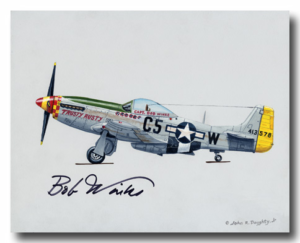
“Trusty Rusty” by artist John Doughty
Becoming an Ace
“On November 18, 1944, near the Neuhausen Airfield (Munich), I got my first victory. We were on a strafing mission, hunting enemy aircraft or enemy surface transportation, of any kind. I was leading ‘Green Flight’ and saw a lone ME-109 on the deck, on a 180-degree course to me. I dropped down on his tail from 5,000 feet, and proceeded to chase him over hill-and-dell until I got closer and he bailed out. On December 24, 1944, in the Fulda Area (Frankfurt on Main.), we were at 27,000 feet and saw a gaggle of enemy aircraft above and to the north of us. I was leading ‘Black Flight’ in Greenhouse Squadron, and took a climbing heading to the north. A fight was going on below us, so I dove my flight down into it before I had used the 75 gallons of fuel in the tank behind my seat. I gained upon an also diving FW-190, gave him two bursts, and he bailed out. I then lost control of my aircraft… the stick was loose in my hand, and I was going down very fast. My plane was in compression, and plunging towards the ground. I chopped the throttle, and my praying and the altitude were sufficient to slow the plane down, and come out of the dive on its own. On January 14, 1945, over Berlin, the 357th FG received a Group Presidential Citation for their action on this day. This day, the Group shot down 56.5 enemy aircraft, the largest number of enemy aircraft destroyed in a single air battle in the ETO. I scored 2.5 aircraft that day, two FW-190s, and I shared one ME-109. The next day, January 15, 1945, I downed a ME-262 at the Airfield at Shongau, which qualified me as an Ace.”
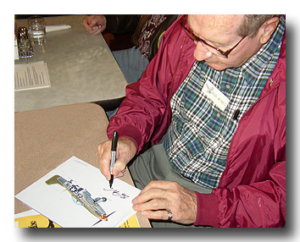
Bob Winks signing “Trusty Rusty”
Mission Shongau
Airfield at Shongau, Germany, 15 JAN 1945. Pete Peterson, the 364th Squadron Leader carried an K-25 Aerial Camera in his P-51 to take pictures of Shongau Airport, because it was a suspected base for Me 262 fighters. The Field Order of the Day gave specific Instructions not to strafe the airfield because of the high concentration of ground-to-air fire power protecting it . I was leading a Flight of four aircraft within the 364th Squadron. The Squadron was at 15K feet when I spotted a lone aircraft doing slow-rolls on the deck flying in a direction away from the airfield. There were patches of snow on the ground, and the aircraft was visible whenever it overflew a patch of snow. I called it into Major Peterson but he was not able to locate it, so he gave me permission to hit it. By this time the bogey had reversed its direction and was coming back toward the airfield. I dropped my external wing fuel tanks at 15K feet, and rolled over into a near vertical dive…5 degrees of flaps with the throttle cut full back. I was closing very fast in a picture perfect combat curve, and when he came into range, I hit him from the high-rear with all six fifties’ 240 rounds, right in the cockpit area. The plane caught fire, half-rolled onto its back, and dove right into the ground, and exploded. From some point behind me, probably not fifty feet away, I heard Pete Peterson say “Nice shooting!” He was right there, camera and all, just in case!
Within seconds I had pointed the nose of my plane into the heavens,…upped flaps… and it seemed that I was being helped along by the Germans exploding 20 & 37 mm rounds behind me. They were everywhere around me, when I discovered that I could not hear the sound of my engine! It was windmilling! No power! NO GAS!, you fool, you dropped the external wing tanks without switching to your internal tanks. SWITCH IT!…and the prop was turning so fast that it must have sucked about ten foot of air lock right out of the fuel line in seconds, and we passed through the 15K foot altitude level somewhere around the speed of sound. Or so I was praying!
With the speed of the dive and the short burst of 240 rounds, I was not certain that it was a Me-262 until I landed in England, and Pete Peterson confirmed it.
Pete Peterson could have taken that kill instead of allowing me to do it. It was his prerogative, as Squadron Leader, and I would have thought none-the-less of him, for doing so. But he gave it to me, and that victory qualified me as an Ace. Pete finished combat as a triple-Ace, but he was much more than that among the pilots of the 364th Fighter Squadron, and the 357th Fighter Group.
Bragging Rights
“The 357th Fighter Group is worth bragging about. Allow me to brag a little. The 357th became operational on February 11, 1944, and flew a total of 313 missions, ending on April 25, 1945. The Group is credited with shooting down a total of 595 a/c, plus 106.5 on the ground, for a total of 701.5 enemy a/c. The 357th lead the 8th Army Air Force with 43 Aces. The 56th FG was second with 41 Aces, and the 4th FG was third with 39 Aces. Also, the 357th FG shot down 18.5 ME-262s, to become the top Jet killer in the ETO. The 357th received two Group Presidential Citations, and the French Diplome De La Croix for help in the liberation of France.”
Robert P. Winks