
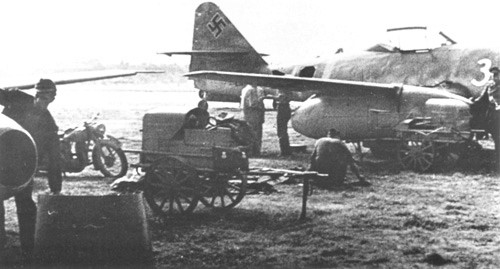
Two Me262s undergoing maintenance at Lechfeld Airfield. The two wheeled vehicle at the center is an oxygen cart.
The Yoxford Boys and the ME262 – American Aviation Historical Society, Spring, 1990 by Merle C. Olmsted
”I spotted a lone 262 approaching from the south at 500 feet. He was going very slow-around 200 mph. I split-essed on it and was going around 500 mph at 500 feet. Flak started coming up very thick and accurate. I fired a short burst from around 400 yards and got hits on the wings. I had to break off at 300 yards because the flak was getting too close. I broke straight up and looking back saw the jet enemy aircraft crash-land about 400 yards short of the field in a wooded field. A wing flew off. I claim one Me262 destroyed”
With this short paragraph, a then unknown Captain Charles E. Yeager described the first confirmed Me262 victory by a pilot of THE YOXFORD BOYS-the 357th Fighter Group, out of the 8th Air Force’s airfield No. 373 on the east coast of England.
The above-described incident is part of Yeager’s encounter report in which he also claims two other 262s damaged. The date was 6 November 1944, and the location was an airfield six miles east of Assen, Germany.
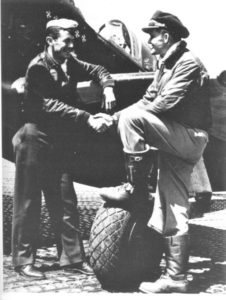
Charles E. Yeager (L) and Donald Bochkay. Yeager scored the 357th Group’s first victory over the jets on 6 November 1944. Bochkay, later C.O. of the 363rd Squadron, shot down two Me262s.
Before continuing with the story of THE YOXFORD BOYS and the 262, we must look briefly at the background of this remarkable airplane, and early combat encounter reports with them.
The jet principle, as applied to turbine-powered aircraft was well known, and by the summer of 1944 when the Me262 reached operational status, British jets had been flying for about three years. The Gloster Meteor F.111, in fact, became operational about the same time as the 262. 616 Squadron was the first to be equipped with Meteors, and had shot down its first V-l “buzz bomb” in August of 1944. By January 1945, 616 had deployed to the continent and become operational with No. 84 Group of 2nd Tactical Air Force. Apparently there were no encounters with enemy aircraft before war’s end. If the war had continued through 1945, the Meteor would undoubtedly have become a factor in the Me262 problem, although it was somewhat slower than the 262.
The U.S. jet program, built around the Lockheed P-80, was beset with delays, and it would have been much later before the P-80 could have been involved in Europe.
Allied Intelligence had long been aware of the existence of the family of jet-powered aircraft in Germany, and had been following their development with growing interest.
Flight Officer Constance Babinton-Smith was Chief of the Aircraft Section of the RAF’s Central Photo Interpretation Unit from its inception in 1940 until war’s end. In her book, Air Spy, she tells us that she had seen her first jet type early in 1942 when the He280 appeared in bomb damage assessment photos of the Hienkel plant. Under the searching lens of her stereoscope, the Me163 appeared in June of 1943 in reconnaissance photos of Peenemunda which the CIU was watching closely due to rocket work going on there.
The most important jet of all, the Messerschmitt 262, was not spotted on recon photos until February of 1944, when Babington-Smith spotted its elegant shape. Six months later the type was operational.
Messerschmitt’s Model 262 must rate as one of the great aircraft of WWII, even though it was not without its faults. Its endurance was short and it was not particularly maneuverable. Its most serious problem, however, was its power plants, which were extremely unreliable. The overhaul time is said to have been 25 hours, but many did not reach that. Of course, the state-of-the-art on turbine engines was in its infancy, and all turbine engines were relatively unreliable. Junkers, moreover, was faced with the non-availability of high temperature resistant materials, and was forced to build its engines with what was available in Germany, which contributed heavily to the unreliability of the engines.
These few faults, however, cannot obscure the fact that this airplane was one of the great aeronautical achievements of the World War II era. With very heavy firepower, and a speed advantage of about 80 mph over the best of the Allied fighters, it posed a difficult problem for the fighter forces of the U.S. and Britain during the last eight or ten months of the war.
The delays in development and production and the tactical misuse of the machine are too well known to dwell on here. The 262 was operational by mid-1944, and the Allied Air Forces had to deal with it.
Soon after they reached operational status, one of them was destroyed by an 8th Air Force fighter. It was the 28th of August, near Brussels, when Major Joseph Myers and Lt. Manford Croy, Jr., of the 78th Fighter Group, caught an Me262 at low altitude and shot it down.
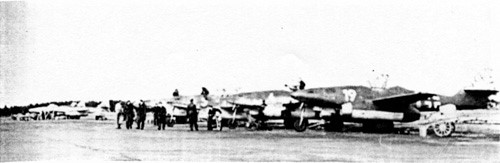
The opposition: A lineup of 262s at Rheine Airfield in the spring of 1945.
The first actual encounter had taken place about a month earlier, on 25 July, when the crew of an RAF photo recon Mosquito managed to survive a lengthy encounter with a 262 by using the Mosquito’s superior maneuverability.
There had been, however, earlier encounters with the rocket-powered Me163, and one, in fact, had been shot down on the 16th of August. On that date, an Me163 pilot made the mistake of trying several relatively tight turns, allowing Lt. Col. John Murphy of the 359th Fighter Group to close in and clobber the unfortunate 163, for Murphy’s 9th and final victory of WWII.
Although Murphy’s accomplishment was the first jet aircraft in history to be shot down by another fighter, the 163 was, with its rocket engine, a developmental dead end in the fighter field. Of more significance was Myers’ and Croy’s destruction of the 262 12 days later, as this was the first victory over a turbine-powered aircraft- the real wave of the future. This is also the airplane that was to cause the biggest headaches for the Allied Air Forces and was also the only jet type which the YOXFORD BOYS were to encounter. For these reasons, it is worthwhile quoting portions of Joe Myers’ encounter report:
“I was leading Surtax Blue flight and, in conjunction with Yellow flight, was providing top covet for the rest of the Group, who were engaged in dive bombing and strafing.
“While stooging around west of Brussels at 11,000 feet, I caught sight of what appeared to be a B-26, flying at about 500 feet and heading in a southerly direction and going very fast. I immediately started down to investigate and although diving at 45 degrees at 450 IAS, I was no more than holding my own in regard to the unknown aircraft. When approximately, 5,000 feet above and very nearly directly over the aircraft, I could see that it was not a B-26, although it had the general overall plan of the B-26. It was painted slate blue in color, with a long rounded nose, but I did not see any guns at this time, because at this point he started evasive action, which consisted of small changes in direction not exceeding 90 degrees of turn. The radius of turn was very great and, although I was diving at around 450 IAS, I had very little difficulty cutting him off and causing him to change directions. He made no effort to climb or turn more than 90 degrees at any time. I closed to within 2,000 feet above him and directly astern and had full power on in a 45-degree dive in an effort to close. At this distance I could readily see the similarity between the aircraft and the recognition plates of the Me262. With full power on and the advantage of altitude I gradually started closing on the enemy aircraft and drew up to within 500 yards astern and was about to open fire when the enemy aircraft cut his throttle and crash-landed in a plowed field. He hit the ground just as I fired, so I continued to fire until within 100 yards of him, observing many strikes around the cockpit and jet units. It skidded over several fields and came to rest and caught fire. The pilot hopped out and started to run. The rest of my flight came over and strafed the plane and No. 4 man hit the pilot running away from the plane. The enemy aircraft was burning brightly, giving off great clouds of black smoke. There were no propellers on the plane or on the ground near it. I claim one Me262 destroyed, shared with Lt. M.D. Croy, Jr., my No. 4 man.”
“As compared to the drawings of the Me262 I noticed the following differences. Wings: The wings were tapered on all both edges and the tips were rounded. The chord of the wing is greater than that as shown in the drawing, especially at the wing roots. Fuselage: Fuselage including the cockpit is very similar to the drawings; also the placement of the cockpit. The nose is not quite so pointed, being about as long: as a P-38 nose. Tail: Almost exactly as illustrated. Nacelles: The engine nacelles stick forward as shown by the drawing, but they don’t extend beyond the trailing edge of the wing quite as far as those in the pictures. The overall size of the plane appeared to be about the same as a P-38, and when viewed directly from above, similar to the B-26.”
During this historic encounter, Myers was flying his assigned P-47D-27-RE, 42-27339, with the 82nd Fighter Sqdn. code MX-S. Croy’s P-47 was MX-M, 42-75551.
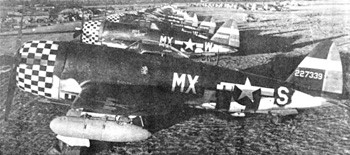
The 262 remained elusive after Myers had destroyed the first of the line, and there were no conclusive contacts during September. By the first of October, Kommando Nowotny, the Luftwaffe’s first jet unit for the defense of the Reich, became operational with about 30 aircraft. The unit was organized with two Staffeln (squadrons) based at Achmer and Hesepe, near Osnabruck. From this point on the jet war became a real concern; the bombers were again at extreme risk from German fighters. During October, U.S. fighters reported 27 combats with the jets, and claimed five destroyed, in addition to two known shot down by RAF units, one by a Spitfire and another by a Tempest.
There was, however, “no joy” for THE YOXFORD BOYS until Yeager broke the ice early in November, as related at the beginning .
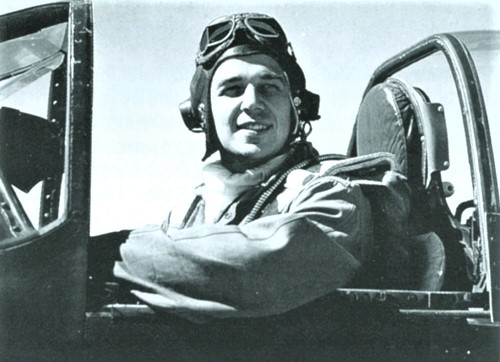
Major Robert Foy, 363rd Squadron, a superb example of the ideal fighter pilot, a man who always pushed to the limit in pursuit of the enemy. After several failed attempts, he finally added a 262 to his final score of 14 air victories.
The mission on the 6th of November was assigned as a target support and sweep of some four-hour duration. Led by Captain Robert Foy, the 55 Mustangs were logged off at 0904 hours. By 1030 they were sweeping the target areas over northwest Germany, and then provided support for 2nd Division B-24s which were bombing the Minden Canal and targets in the Minden area (a town some 60 km west of Hannover). Foy then led the P-51s on another sweep in the area north and east of Minden specifically in search of jet aircraft. Foy reported the events as follows:
“Contacted five jets (Me262s) N of Osnabruck flying in elements of two and three respectively at 10,000. Two flights followed two jets in climb towards Bremen, but jets pulled away after leveling off and believed to have landed at an AD at Delmenhorst (4RW4796), 15-plus 262s observed on field which has a green metal hangar and is very heavily defended by light flak. Flights went in to strafe, shot up three flak emplacements and were driven off by very heavy fire from machine guns mounted on housetops adjoining AD. Same flights observed at 1150, three Me262s on military highway with evidence of highway being used for takeoff and landings. Did not strafe because of gas shortage. Another flight followed the other three 262s at 10,000 to AD at 4VR8060. Destroyed one at 1,000 over field, heavily defended by flak and damaging two in vicinity of field. Flight saw four other 262s on field, whose runways were estimated to be 6,000 feet long. Two flights strafed AF at 4RW850 on which 10 of 20 unknown aircraft were damaged. The SE enemy aircraft were well camouflaged and some were dispersed in plowed field adjacent to AD. No jets or other enemy aircraft seen in target area. LF out 1230 Egmond.”
Foy, the mission leader, had his first chance at the jets, but failed to score. In his tactical report, Foy says:
”Just north of Achmer airdrome, I received a call on R/T at 1100 hours stating that bandits were engaged in area north of Osnabruck. I retraced my course and returned to the area. Flying at 10,000 feet, 1 saw five Me262s at 8,000 feet; two of these were about 100 feet lower than the others. I dispatched Cement White and Green flights after the high enemy aircraft and turned to engage the low two Me262s. The enemy aircraft were closing on two P-51s who were apparently unaware that they were about to be attacked. I dove on to the 262s and was closing when the tail-end 262 apparently saw me. He started a gradual climbing turn to the left and it appeared he climbed at a steeper angle as he gained altitude. During the climb at an altitude of 15,000 feet, I was closing in on him and always gaining during the climb. He continued turning to the left, leveling off as he did so, and pulled away from me gradually. He continued to pull away going into a shallow dive on a straight course. He dived into the clouds and I immediately dove under the undercast. The two 262s appeared beneath the clouds and just ahead of me. I took chase but in level flight their speed was obviously greater than ours. I followed them for several minutes and saw them land on an airfield just southwest of Bremen and very close to town. I hit the deck and started a run to strafe the field. Immediately a wall of flak came between myself and the airfield. I turned off to the right and passed over a small town named Mahndorf. I observed as I passed over the town that the houses closest to the airfield were used as gun positions (machine guns). I hung to the deck and made 180-degree turn in toward the field. It was during this run that I strafed two flak emplacements and one machine gun emplacement. The flak emplacement personnel were eliminated but heavy accurate fire from the other emplacements made it impossible to hit the field .”
One of the two jets pursued by Foy was almost surely flown by a man named Helmut Lennartz. At the time they encountered Foy, the two had been aloft long enough to be very low on fuel, and had hoped to land at Achmer or Hesepe. However, a swarm of U.S. fighters in these areas precluded this, and the two made for Bremen, using only enough power to keep ahead of Foy. As Lennartz was on final to Bremen, both engines quit due to fuel starvation, and he made a rough landing, damaging the landing gear.
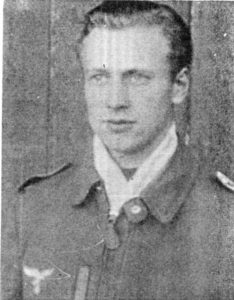
Me262 pilot Helmut Lennartz of JG-7, who was flying one of the 262s that Foy attempted to catch on 6 November. Lennartz is credited with shooting down a B-17 on 19 March and survived the war.
Other than a few ASR P-47s and photo recon Mosquitos, the 8th AF conducted no operations on the 7th of November.
On the 8th, a small force bombed oil targets at Merseburg, with some 800 fighters in support. Bomber and fighter losses were light, but the 357th scored again against the new enemy, the 262. This time, both victims were known, and both were Luftwaffe old-timers.
Four 357th pilots were involved in these two separate actions, and both encounters were in the same general area, one near the well-known checkpoint of Dummer Lake, and the other in the Quakenbruck vicinity, a few miles northwest of Dummer Lake. Both were also within a few minutes of each other.
Lt. Warren Corwin of the 362nd Sqdn. had developed a rough engine in his P-51B, 43-12227, in the target area, and had taken a course for home, escorted by Lt. James Kenney. About one hour into the return, at approximately 1230 hours, they came upon a box of B-17s on the same course, but with no escort. With Corwin’s engine running reasonably well, Kenney suggested they provide escort for the ’17s, and his encounter report takes up the story:
“As we climbed above them to 22,000 feet, we saw a lone bogey going 180 degrees to the bombers. We broke into it and saw that it was an Me262. It climbed, turned towards the bombers, and passed them. Then it turned and made a pass from 10 o’clock. When it started to make a pass from 5 o’clock I got on his tail with Corwin behind me. I began firing from about 400 yards at 30 to zero degrees deflection. I saw a puff of red smoke come from him. He dove for the deck and Corwin split-essed. I rolled down on him and got on his tail again. He was diving very shallowly and I overshot him twice, doing 300 mph. The first time he kept straight ahead, but the second time he made a medium turn to the left. I out-turned him and got behind him again, firing from 250 yards to zero yards, dead astern, with no observed strikes. Smoke was coming out of the right nacelle, however, and the pilot bailed out at 4,000 feet. I think he was probably out of fuel. The ship was dirty gray with a blue tail and the wings were swept back and narrow. Judging from my experience, the 262 apparently cannot dive or turn sharply.”
During this flurry of action, Warren Corwin was hit by gunfire of unknown origin, but almost surely from the 262. At the time, Kenney was not aware that the 262 had fired at either of them. However, Corwin had split-essed and disappeared from Kenney’s view. We can only speculate that Corwin was attempting to get into firing position on the jet, misjudged his timing and instead became the target. Corwin reported that he had lost a foot or so of wing and had been hit himself. Kenney never saw him again, and he has often been reported as landing near Brussels and later dying of his wounds. Despite considerable effort this writer has never been able to trace Corwin’s fate. As late as July 1945 he was still listed as missing. As of 1988, he is not buried in any of the U.S. military cemeteries in Europe, nor is his name on any of the Walls of the Missing.
The Me262 pilot, whose aircraft was hit moments later by Kenney and who bailed out, has been identified as Oberleutnant Franz Schall from Kommando Nowotny, and an ace with some 100 victories. One report says he had shot down three P-51s on 8 November before encountering Kenney and Corwin. It is not known if this includes Corwin.
A few miles away, at 30,000 feet, near Dummer Lake, Captain Merle Allen and his wingman, Lt. Edward Haydon, were about to play a part in the elimination of one of the Luftwaffe’s great stars.
The 364th Squadron had had a good day strafing targets west of Hannover, with, among other targets, 10 locomotives, three trucks destroyed, and two windmills damaged. Separated from the rest of the squadron during the melee, Allen and Haydon were headed home alone when they spotted a lone Me262 below them. Both went to max power and gave chase with Haydon now in the lead. Merle Allen recalls: ”As I remember 1 saw the 262 from about 25,000 feet and he was flying on the deck going in the opposite direction. We split- ess’d and had no trouble overtaking the 262 as he probably was returning to base at a slow cruise speed.”
The skies were crowded with P-51s and others were also hounding the 262, with Captain Ernest Fiebelkorn of the 20th Group, and his wingman also converging on the target. The 262 led the P-51s over an airfield, and the immediate flak response scattered the Mustangs momentarily. However, Haydon and Allen, and possibly the two 20th Group machines, again caught up with the 262 at low altitude and apparently very near Kommando Nowotny’s airfield at Achmer. Although Allen and Haydon were about to open fire, neither did as the 262 rolled onto its back and hit the ground in a giant fireball. Since none of the P-51s had opened fire, the cause remains unknown, but there was a great deal of flak and the 262 may have been a victim of this. The pilot of this aircraft had been Major Waiter Nowotny himself, and his death soon spelled the end of the unit bearing his name. Merle Allen did not submit a claim since he did not fire his guns, and the victory was credited jointly to Haydon and Fiebelkorn.
With the deactivation of Kommando Nowotny, the surviving aircraft and pilots were assigned to a new jet unit, JG7.
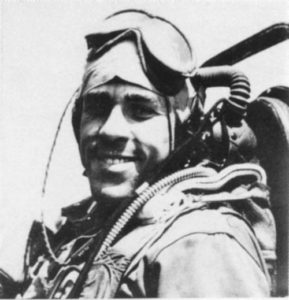
The only know 357th loss to the jets was Lt. Warren Corwin, shot down by Franz Schall on 8 November 1944.
For the remainder of the month of November there is no mention in the mission reports of any further sightings of the jets. However, there was other game afoot, and the group claimed over 50 victories for the month.
The mission reports remain devoid of jet sightings until the 15th of December when four of them were seen 20 miles south of the RV point, at 35.000 feet. The jets flew the bomber course for 15 minutes and then disappeared.
The month of December brought very bad weather, with the 357th flying only 18 missions. Jets were reported again on the 23rd, the 24th, and the 25th, but did not initiate any hostile action and were not engaged.
Even with the bad weather, the group claimed 64-2-2 victories for December, all Bf109s and Fw19Os except for a radar- laden Ju88 shot down by Robert Foy. The group lost seven pilots during the month, with three KIA on Christmas Eve.
The end of 1944 found the Luftwaffe attempting to bring order out of the chaos surrounding its new weapon. By late in December, the three Grupes of newly formed JG7 were dispersed to three different bases at Brandenburg, Neumunster, and Parchim.
Soon after the first of the year, a second unit was activated, with the designation Jv44 (it was of a size between a grupe and a geschwader). Also close to operational status in January were two former bomber units, being reformed as jet fighter wings. These were Kg(J)6, and Kg(J)54 (the KG were bomber designations, the J indicating conversion to jets). These units were beset with difficulties, however, as it was not a quick process to retrain bomber pilots into anything like competent fighter pilots. The difficulties reached massive proportions when the results of constant air raids on their bases, shortages of fuel, spare parts, etc., were considered. It was to be early February before either unit flew its first combat sorties.
Considering the great effort devoted by the Luftwaffe into making the Me262 into a bomber (against their will), it is probable that most of the Me262 sorties in December were hauling iron bombs in support of the German’s Ardennes offensive.
Sometime in December or January, Colonel Irwin Dregne, commander of the 357th Fighter Group, analyzed the meager information on the 262 tactics and wrote the following: “It was found that a flight of four P-51s could box in an Me262 and prevent it from evading. This tactic is being developed by the Group and will be used when possible. It is considered that if P-51s have initial advantage of altitude and position and a numerical superiority of 4 to 1, jet-propelled planes can be destroyed on every encounter.”
In retrospect it sounds a bit optimistic, but if the 262 pilot cooperated and made the required mistakes, it was certainly possible.
Other than a few random sightings, there was no contact with jets until mid-month. January managed to be even worse, weather wise, than December had been. Mean temperature for the month was 33 degrees E, with ground and runways either frozen or snow-covered on 18 days. Fog, freezing rain, snow, haze, 9/l0ths cloud, zero visibility-January had it all.
The Group flew missions on only 15 days of this month, but one of these, the 14th, turned out to be the Group’s “Big Day,” and a record setter, with 55.5 air victories.
By January of 1945, the skies of Germany had long since become extremely hazardous for any German aircraft, operational type or not. A moment’s inattention by a Luftwaffe pilot or crew, could be instantly fatal. Such was the case on the 15th. An Me262 pilot, probably exhibiting his joy at flying such an aircraft, was spotted doing a series of slow rolls at low altitude SW of Munich, and paid for it with his life.
The Field Order for the 15th detailed the 357th as escort to 2nd Division B-24s which were to bomb the airfield at Leiphem. Since this was covered by 10/10ths cloud, the B-24s bombed secondary targets, with no fighter opposition. Lt. Robert Winks, of the 364th Squadron, was leading Green flight when someone spotted and called in an airdrome near Sclhnogan with some 15 262s in a neat line on the field. In his encounter report, Winks described what happened.
“Major R.A. Peterson was leading, but had instructions not to strafe as the Field Order for the day so specified, so he orbited the squadron over the airfield in order to take aerial photographs. While doing this I sighted an enemy aircraft doing a series of slow rolls on the deck and immediately called it in. No one could locate it so I went down from about 15,000 feet, got on his tail, and fired a good burst just as the enemy aircraft was again approaching airdrome. I observed many strikes, and the fuselage burst into flames. The enemy aircraft crashed on the edge of the field and blew up. The pilot was not seen to get out. Because of camouflage I was not certain of enemy aircraft’s identity until landing at home base when I was informed it was an Me262.”
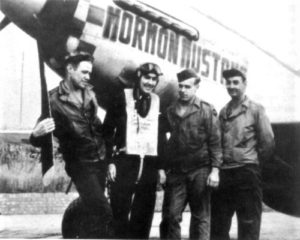
Lt. Roland Wright, with his Morman Mustang, 44-73219. His crew is Sgts. Don Roepe, assistant crew chief, Ken Arveson, armament, and crew chief Earl Lloyd at right.
Although the group flew an escort on the 16th, there were no sightings of enemy aircraft, with most pilots being directed to land at continental bases due to heavy fog at Leiston. Eleven P-51s which had left formation early due to low fuel state, returned to English bases, but Lt. William Thompson was killed attempting to let down through the foul weather.
The next day, with only 13 aircraft available at home base, this small formation flew an uneventful four-hour escort to Bifield. There was then a three-day stand-down, until the 20th, when most of the Group’s pilots had returned to Leiston. On this date, the 262s were again encountered and two of them were shot down.
Lt. Col. Andrew Evans led the mission, escorting 3rd Division B-17s, again in marginal weather, which were bombing marshaling yards at Heibroon. Two 262s were seen about noon in the Augsburg area, but neither was engaged. However, another was spotted in the target area at 18,000 feet, and Greenhouse White 1 and 2 (364th Sqdn.) broke off the escort and gave chase. The section was led by Lt. Edward Haydon with Lt. Roland Wright as White 2. Wright’s encounter report tells us:
“We were chasing an Me262 about 1315 hours on the deck, and as it started an approach to land at Lechfield airdrome, we turned across the edge of the field in order to fire on him. We were at an altitude of about 700 feet and Lt. Haydon was hit by flak before he could fire and pulled up and bailed out.”
“I continued on in, getting close to the deck, and saw numerous strikes on the cockpit and wing area of the enemy aircraft. The 262 went off the runway. I stayed on the deck taking evasive action until I was away from the field, as the flak was thick all around me. After getting away from the field I looked back and saw black smoke coming from the field and believe the 262 burned.”
Major Richard Peterson, leading Greenhouse Squadron, and watching from above, confirmed the 262 on fire. Haydon, who had shared credit for the Nowotny victory in November, had successfully bailed out however, and spent he remaining few months of the war as a POW.
After outrunning the flak around Lechfield airdrome, Wright joined up with Peterson and his wingman, Lt. Ernest Tiede (a 363rd Squadron pilot) and the three headed for home. However, Wright knew he did not have enough fuel to return to home base, and to add to the problem the weather was very bad, and his oxygen supply was exhausted. Roland Wright recalls: “We tried to establish radio contact without success and we thought we might still be over occupied France. We finally broke out of the clouds and the terrain was small rolling hills and the ground was snow-covered, with a low cloud ceiling.
”We were looking for a place where I could land, or belly-in. When my last tank read empty, I called Pete to tell him I was going to climb into the clouds to get enough altitude to bail out. Just as I started up we came upon a small town and Pete spotted a small snow-covered field with a hangar and a German fighter parked by the hangar. I decided to land it there and call Pete if we were in German territory and if we were he was going to try to set my aircraft on fire. I landed OK and the engine quit just as I touched down, out of fuel. A vehicle with military personnel came toward the airplane and they turned out to be Free French. I called Pete to tell him we were in friendly territory and he and Tiede also came in and landed.”
The small field turned out to be southeast of Paris, and as there was no aviation fuel available, the three remained as guests of the French for five days until fuel arrived in five- gallon cans.
Even then the long mission was not over, as on arrival over England everything was socked in solid and they were able to land only by letting down, one at a time, over the North Sea and flying north until they got a DF steer to the runway heading. Even now, 45 years later, Peterson and Wright are still proud of the precision flying that returned them to base, ending a mission which had begun five days before. Some 40 minutes prior to the action at Lechfield, another Me262 had fallen to a 364th Squadron pilot.
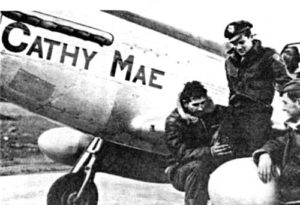
Dale Karger with one victory over the 262s, became the youngest ace in Air Force history – still 19 at the time. Seen here on the wing of his P-51D, Cathy Mae. It went missing in action with Fred McCall before Karger flew it on ops. It was replaced with Cathy Mae II, squadron code C5-U.
1st Lt. Dale Karger was young, even in a war where youth was the norm among fighter Pilots. On the 20th of January 1945, Karger was still about three weeks short of his 20th birthday, and with four victories behind him, was about to become, as far as is known, the youngest ace in U.S. aviation history.
Greenhouse Squadron was strafing targets in the vicinity of Ulm, when two contrails were observed at about 32,000 feet, spiraling slowly downward. Karger, with his wingman, 2nd Lt. Lloyd Zachariae, began a spiraling climb and at about 15,000 feet the source of the contrails was revealed as 262s. As the Mustangs continued to climb, one of the 262s turned into them on a head-on pass, but did not fire. It then straightened out on a long dive toward Munich. Although the jet pulled away until almost out of sight, Karger and Zacharie followed. Possibly thinking he had lost the P-51s, the Luftwaffe pilot made the mistake of initiating a long turn to the left. The Mustangs cut across the corner, Karger fired a burst at very long range, and was surprised at a flash in the cockpit area. The pilot then bailed out and the 262 split-essed into the ground.
Both P-51 pilots then strafed the pilot on the ground, but his fate is uncertain. Zach remembers that he missed, but thinks Karger may have hit him.
As with Peterson, Tiede, Wright and eight other pilots, Karger and Zachariae were low on fuel, forcing the latter to put his aircraft down on its belly, somewhere in France. Karger also landed at the same location.
In similar situations as this, the two pilots often shared credit for the victory. However, Zach did not put in a claim, and in any case his gun camera film was inaccessible since the P-51 was resting on its belly.
With this victory, Karger scored his fifth victory, and ws to end the war with 7.5.
January came to a close with no more jet encounters. Four of the elusive machines had been destroyed, a very small part of the 61.5 victory claims during the month. 66th Fighter Wing (357th Group’s parent unit) reported that, at the end of January, of the top 17 aces in the wing’s five groups, 10 were 357th Group pilot.
February was the least productive month in terms of air victories. There were no air claims during the month except for two Me262s early in the month. the Group did a great deal of strafing in February, resulting in some interesting claims. On the 27th, along with the usual trucks, locomotives, etc., a bread truck, a lumber mill and a “staff car with Jerry officer,” were listed as destroyed. Earlier in the month, three high-tension lines were claimed. Since it would be very difficult to destroy high-tension lines with machine gun fire, it is likely someone carried them away with part of his aircraft. Three pilots were lost during the month, one of which survived as a POW.
The 8th Air Force launched a max effort on the 9th of the month, with all bomb groups and all fighter groups operating. Oil installations were the primary targets, and although there was some Luftwaffe reaction, bomber an fighter losses were low. Combined claims for all fighter units were the primary targets, and although there was some Luftwaffe reaction, bomber and fighter losses were low. Combined claims for all fighter units were only 24, with five losses.
By early February, at least one of the two Luftwaffe bomber units which had been retraining on the jets was considered ready for operations.
On the 9th, the 1st Grupe of KG(J)54 flew its first combat sorties, and suffered severely. Of their 15 M262s, four were shot down, and two were lost to crashes. Among those lost was the Wing Commander, Obstlt (Lt Col) Riedsesel, two Staffel Commandes, and the Grupe Commander, Major Ottfried Sehrt, who was wounded.
On this day, 8th AF fighters claimed four 262s, one by the 359th, one by the 78th, plus another as a probable. the other two were claimed by the 357th, with another probable. Apparently, all he victims were KG(J)54 machines and pilots.
As was common at this period of the war, the 357th Group was operating as two separate units, with A group led by the Commander, Col. Irwin Dregne, and B group by Major Richard Peterson. A group stayed with the bombers from rendezvous until land fall out, with no e/a contact – a milk run.
B group, however, dropped tanks and left the bombers to engage 262s near the noon hour. Although they rejoined the bombers after the action, they broke off in the target area due to fuel shortage and headed home.
It was almost 1130 hours, in the vicinity of Fulda, when Robert Foy of the 363rd Squadron first saw the jets. He reported:
“We were in the area of Fulda flying on post side and in front of number six box of bombers when I observed a flight of four Me262s at about 9 o’clock low to my flight. They were flying a finger four formation and after I gave Cement Squadron orders to drop tanks, I observed five more Me262s behind and a bit lower than the lead four. This second flight of jets was also flying a finger formation echeloned to the left with No. 5 jet in the trail with No. 4 jet. I dived to attack the lead section of the leading formation of four and they broke into elements of two. The lead element started a wide turn to the right and the second element broke to the left. Just as I pulled up well in range of the element of two jets which broke to the right, the No.2 jet split-essed and straight toward the undercast. I continued on the tail of the lead 262 and he continued turning to the right back into bomber formation. Several strikes were observed on his wings but he continued on to attack the bombers from about 7 o’clock and low. He went directly beneath the bomber formation and I was in close trail with him giving him short bursts and obtaining many strikes on his wing, both left and right. The 262 turned left, made a feint at the bomber formation and it was during this turn to the left that I gave him a long burst hitting his left engine which began to smoke quite badly. The jet swerved to the right as his left engine started to smoke, and then he straightened out on a straight course and pulled rapidly away from me.”
Foy then states that he had to back off as his engine was running extremely rough due to the fact he had been pulling 64 Hg (inches of mercury manifold pressure) at 3,000 rpm for over 10 minutes.
Of course, he could only claim a probable due to the fact he had not seen it go down. Robert Foy was a real tiger, and after flogging his engine deep in hostile country, and firing all of his ammunition (1,560 rounds), it was obviously a disappointment to be able to claim only a probable. He ends with this assessment: “If the Me262 did land safely, he weighed considerably more than he did when he took off and his ship will not fly again until they do an extensive repair job. I fired all my ammunition and from appearances of strikes on e/a, fully half of the rounds hit him.”
When Foy dropped tanks and dove away in pursuit of the two jets, which then broke right, 1st Lt. Johnnie Carter, leading Cement Green flight, followed. When the four 262 pilots had spotted the P-51s, they had split, two breaking right and two left. Foy had tacked onto the leader of the two breaking right, and Carter took the other. Although Carter fired a few burst and followed for about 10 minutes, the jet rapidly outdistance him. While engaged in this fruitless pursuit he spotted another 262 about 12,000 feet below him, and apparently gliding without power. This was too good to miss, and Carter split-essed onto the one below. Closing rapidly, he fired and saw strikes, as the pilot jettisoned his hood and bailed out. This was Johnnie Carter’s fourth and final victory of WWII.
Of the four 262s initially spotted by Foy, we have accounted for the two which broke to the right. The Leader, although heavily hit by Foy, was not seen as destroyed, and claimed as a probable. The other easily outdistanced Carter, who then found another and shot it down. That left the two that had broken left, and Captain Don Bochkay’s fascinating encounter report will deal with these two.
“I was flying wing to Captain Browning who was leading Cement spares on an escort mission of B-17s to Leipzig, Germany. We were doing nicely on our escort at 26,000 feet., crossing our bombers and holding a good formation. At 1115, around the Fulda area, four Me262s were called in by one of our flights, under us at about 4,000 feet below, heading toward the bomber formation. We dropped our tanks and broke up, two dove to the right and two dove to the left. Captain Browning never did get within range of the two going left and down. I climbed high, balls out, keeping the Me262s in sight as well as covering Captain Browning.”
“I climbed to 28,000 feet and leveled off. Just as I leveled off the two 262s broke right in a steep climbing turn. I called Captain Browning and told him I was cutting them off. I dove my ship to gain more speed. The sun was in my favor and I believe the Me262s did not see me. I came in on the lead 262 but couldn’t get my sights on him. I passed under the lead 262 and broke hard to the right, coming out on the second 262’s tail at a very good range of 300 yards. I fired a long burst as he was pulling away from me, but I observed some very good hits about the canopy and the right engine. That really slowed him down. The lead Me262 headed straight down. the one I hit broke to the left in a gentle turn so I opened up on him again at about 400 yards, and kept firing all the way in on him. I saw many strikes all over him and his canopy shattered, along with large pieces flying off the e/a.”
“I broke off to the right to keep from running into him. As I passed very close to him the pilot was halfway out of his cockpit. The ship then rolled over on its back and the pilot fell out. The pilot never opened his chute and the plane went straight in. I then pulled up in a climbing left turn to rejoin Captain Browning, but we got separated because of so many P-51s in the area with the same colored tails.”
“I found myself alone so I set out to join up with someone in our own bunch. I saw another 262 diving and going like hell followed by about five P-51s, but out of range. I was about 7,000 feet above them. The Me262 then started to climb to the left, so I firewalled it again and cut him off in a left turn, pulling my sight down on him at about a 20-degree angle at 400 yards. I pulled the trigger but only one gun fired, about six or seven rounds come out. I did not see any hits on him, so broke off, leaving him to someone else. I then returned alone, out of ammunition and with my windshield covered with oil from the first jet that I shot down.”
After another hectic encounter of the 9th, the jets remained elusive for the 357th, and for other groups as well, until the 22nd of February. On this date all allied air forces began OPERATION CLARION, widespread attacks on marshaling yards and transport targets.
Jet aircraft did appear in some target areas, and Foy, who was again leading the group, reported sighting three jets southwest of Stuttgart which easily evaded. the only other jet encounters during February occurred on the 25th when the 55th Group caught them taking off from Giebelstadt and shot down seven. All of these appear to have been from the ill-fated KG(J)54.
The last week of February saw a combination of bomber escort jobs and participation in OPERATION CLARION with attacks on a wide variety of ground targets, including a motorcycle and rider on the 24th, a bread truck on the 27th, and a windmill on the 28th.
As March came in the Luftwaffe was beginning to achieve its goal of getting the jets into action in relatively large numbers, making coordinated attacks on the bombers and avoiding allied fighters as much as possible. For THE YOXFORD BOYS, the month provided only two claims of 262s destroyed, with another six damaged. Other 8th Air Force fighters raised the month’s total air victories to over 40, and late in the month, 15th Air Force Mustangs, escorting their B-17s to Berlin, had a good day, knocking down eight Me262s, three for the 332nd Group and five for the 31st.
In a report written sometime in March, Colonel Irwin Dregne, 357th commander, presents the changing scene in regards to tactics as it appeared in this second to the last month of the war:
“The German Air Force fighters have been inactive in the defense role, the burden of the bomber interception falling on the me262. The number of jet-propelled aircraft, and the aggressiveness and frequency of their attack have increased markedly during this month of March. It has been found necessary for the group to devise and develop new escort tactics to protect the bomber columns from attacks by these jet-propelled huns.”
“The group now flies rather close escort to the bombers, keeping in flights and sections. The former tactic of having squadrons forming a loose perimeter around the bomber boxes has been abandoned. The new method of defense permits our fighters to turn into the attacking jets an drive them off before they break through. It has been found that our formations must not permit the maneuvers of the jets to draw them too far away from the bombers they are escorting, because the jets, with their superior speed, are able to pull up and turn so swiftly into the now unprotected bomber boxes, leaving the P-51 pilots far behind and therefore helpless as a defender.”
The group stood down on eight days of March, flying missions on 22 days, often two a day. The month started with a burst of violent action on the 2nd, with claims for 13 190s and 109s shot down, plus another 25 on the ground, and adding three locomotives and five trucks. The cost was too high for the results that late in the war, with three pilots killed and two surviving as POWs. All but one had been victims of ground fire.
No jets were seen, but the next day John Sublett of the 362nd and Ivan McGuire of the 364th at least got a shot at a pair of 262s when six of them made several attacks on bombers under escort. The mission report says, “These e/a did not attempt combat with our planes, but would evade and then return and attack a different box.”
Captain Sublett was leading Dollar Yellow flight when he saw a single Me262 make an attack on a B-24 formation, from 12 o’clock high. Sublett says in his ER: “I immediately gave chase, my flight following me. We chased him for five minutes, when he made a 180-degree turn and started a large circle. I dropped my tanks and cut the circle. From long range I finally managed to fire two bursts, observing pieces coming off on the opposite side of the 262. The damage could not have been very severe though, for he poured on the coal and took off in an astounding hurry going south between Magdeburg and Berlin. He kept letting down, disappearing from sight below the clouds an d30 miles southeast of Magdeburg. It would have been futile to follow.”
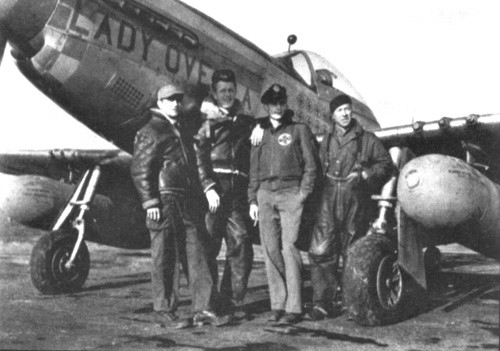
John Sublett and crew.
For over two weeks, all missions were straight escort jobs with no e/a seen. the flak was still taking its toll of the bombers. On the 15th the group leader reported observing four separate incidents in which B-17s were shot down by the big guns.
On the 19th, field Order 1785A detailed the 357th on another escort, this time to Ruhland, with Lt. Col. Andrew Evans leading. T.O. and RV were uneventful, but shortly after 1400 hours, in the vicinity of Chemnitz, the group pilots were to witness the largest concentration of jets yet seen. Evans reported: “36 Me262 attack bombers at 1408 Chemnitz. They came in at a B-17 from 6 o’clock high in waves of 12, each wave consisting of four flights in V formation. Two of these line abreast and two flights slightly high and behind. the 262s seemed to be attacking at relatively low speed. Our 363rd Sqdn., led by Lt. Col. Hayes, was able to prevent the last two waves from hitting the bombers. These jets broke and went into a slight dive breaking into two-ship elements which easily outdistanced our pursuit. No other attacks were made on our combat groups. The weather was ideal for jet attacks as they attack out of cloud cover, thereby preventing our proper positioning and early interception.”
Although Colonel Jack Hayes had been able to turn away two of the attacks, the 3rd had been lethal to the bombers, with four going down. these were all 3rd Division b-17s, one from the 96th, one from the 385th and two from the 452nd. Evans reported 19 chutes from the four B-17s.
When Hayes led the 363rd Squadron into the 262s of one wave, Captain Robert Fifeld, showing considerable perseverance, managed to “kill” one of them: “I was leading the second element of Cement Blue flight when 20-plus 262s attack our box from 6 o’clock, slightly high. I dropped my tanks and tried to beat them to the bombers. I got there just as they hit. I shot at about four different one and finally singled one out. They were all diving and to the left. They were getting away from me so I tried lobbing some long range shots in and finally got some black smoke trailing from him. After that he slowed down and I started closing in on him. After that he slowed down and I started closing in on him. they seemed to fly in elements of two. After I got some more hits, his wingman got up close to him and then took off again when I got some more hits, I closed up to about 400 yards and got many hits. He trailed some white smoke and then went straight in. I never exceed 400 mph and they seemed to be only about 50 mph faster than us. When the 262 went in, it exploded.”
During this same action, Lt. Joe Cannon had his only chance at a 262, and missed, at least partly due to failure of a small light bulb. When Cannon spotted the 12 262s coming in on the bombers, he broke into them, and when at only 200 yards range, he fired a short burst at one, getting some strikes on the tail. At this point, his gun sight “went out” and although he sprayed the area, he had no further luck, and the flight of 262s broke left and rapidly left him behind. He could claim only a “damaged.”
Major Robert Foy, who had been frustrated in previous attempts at jets, finally got his revenge on this date. About 20 minutes after the initial action in which Fifield had scored, and after leaving the bomber formation, Foy, who was leading Greenhouse Squadron, and was low on oxygen, began a descent to a more favorable altitude. Like most of Foy’s encounter reports, this one is of great interest:
“I took up a heading for home base and observed four unidentified aircraft flying a course due south at 10,000 feet. I took off in a chase and as I closed up on them I could identify them as P-51s. Just as I was about to break off and resume course for base, I observed three Me262s in a shallow dive toward the four P-51s. the jets continued in their dive on the P-51s and in a course of approximately 60 degrees. I turned left to cut them off and at about 6,000 feet the jets leveled off on a straight course, flying a V formation with the jet on the left side a bit further behind.”
“The jets apparently did not see our flight at first as we started to close on them. Suddenly they appeared to pull away from us, although I had everything firewalled and indicating 390 mph straight and level flight. My engine started to detonate and although I was still a bit out of range, I pulled the K-14 sight pip just a bit high of the jet aircraft and gave him two good short bursts just for good luck. I was frankly surprised to see the left engine nacelle of the jet start smoking a black trail. The jet immediately did a half roll to the left into a split S. No chute was observed and the jet continued in its dive from 6,000 feet into the ground when ait struck in a cloud of flame and smoke just west of an airdrome.”
Foy’s victim may have been Oberfeldwebel Mattuschka of JG7, who was killed in action at about 1500 hours, within a few minutes of the time reported by Foy. JG7 was also apparently the unit involved in the earlier combat, as four of their pilots claimed B-17s this date. Two of these pilots were probably men who earlier had had contact with the 357th. Oberfeldwebel Helmet Lennartz is almost surely the same man who escaped Foy’s chase on 6 November, and Oberleutant Schall is probably the same man shot down by Bill Kenney on 8 November, and who was killed in action six months later.
The jets were much in evidence on the 21st of March, and other 8th Air Force fighters had a good day against them, claiming nine 262s, six to the 78th Group, and three to the 361st. Foy was again leading the group and his comments in the mission report are a clear indication of the difficulties posed by the jets: “About 20 Me262s, at 25,000 in formations 2/4 attacked box to our rear 0930 – 0945 hrs. One sqdn attempted to engage but they easily pulled away. Twelve 262s attacked Vinegrove 1-2 NE Koblenz at 1110, attacking from 6 o’clock high out of the sun. Enemy in close three-ship formation, two flight abreast, and two flight high and slightly to the rear. They attack high squadron and then broke up into the sun. We were covering Vinegrove 1 – 1 and not in position to intercept. Nuthouse called out attacking formation just as they passed thru the bombers.” (Nuthouse was fighter controller’s call sign.)
There are 14 items listed under “observations” including: 1. Three B-17s down NW Dresden from jet attack. four chutes. 2. One B-17 headed for Russian territory, shot down NE Dresden 0950, by Me 262. Five chutes. 3. Plane believed to be fighter exploded due to jet attack SW Ruhland, approx 0935, at 22,000. 4. Me262 attack by two P-51s NW Fulda, enemy pilot bailed out. 5. One Me262 shot down by blue-nosed P-51 north Giessen.
The 24th was another day of violent action with the group claiming 16 air victories and a long list of ground targets, with no losses. This was the date the allied armies fought their way across the Rhine, and the group was on area patrols in stead of the usual escort. All claims for Bf109s, except for a single 190 that Foy added to his score. No jets were seen.
The last two days of the month and into April saw elements of the 357th engaged in a dramatic attempt to rescue one of their own from the waters of the North Sea, and from the enemy. What was to be a huge rescue attempt ultimately failed, but the pilot was captured and survived the war. Since the affair did involve the Me262, it is worth exploring in detail.
The mission on the 30th had been generally uneventful, the Mustangs leaving the bombers after an hour and a half escort, and heading from home base. Soon after leaving the coast, Lt. Daniel N. Myers, 363rd Squadron, had the shattering experience every fighter pilot dreads – an engine failure over open water. Myers was flying P-51D, s/n 44-72328, and when his coolant system packed up, he left the warmth of the cockpit and took to his chute, from which he successfully transferred to his dinghy. Other members of his flight orbited the dinghy, calling for ASR and “fresh” fighters to take over the cover. Other than the expected hazards of the operation, Myers was only about four miles off the Northwest tip of Schiermonnikogg Island, which is part of the West Frisian Islands, and just north of Groningen in the Netherlands. It was a toss-up as to who would get to him first, the Air Rescue Service or the Germans.
Leiston immediately launched four P-51s, led by John “Pappy” Stern, to escort a PBY of the 5th Emergency Rescue Squadron to the scene, where they arrived soon after 1900 hours, relieving four P-51s of the 359th Group.
Myers was firing flares and the PBY had no difficulty finding him and landing. Soon after, closing weather darkness made it necessary for Stern to bring his flight home without knowing if rescue had been effected.
Unfortunately it had not. During or after landing the PBY had suffered an engine failure and was unable to retrieve Myers. The “Cat” crew now had their hands full with their own problems.
Major Leonard “Kit” Carson was an original member of the 362nd Squadron, of the 357th Group, and except for a brief stint in the ZI, he was with the group from the beginning to the end. He was to finish the war as the group’s high scorer with 22 victories, of which 18.5 were air victories. Included in this total were five in one day. Now, in March, he had recently taken over as C.O. of the 362nd Squadron,. He takes up the story of Dan Myers the next day, 31 March 1945:
“The next morning I was alerted by Group to scramble with a flight of four and find Myers and the down PBY. The weather was still spotty, but the visibility below the cloud deck gave us a good chance. I knew the Frisian Islands well so no briefing or detailed navigation plots were necessary. We threw on our suits, boots and chutes and went charging off to the northeast. No telling what the Germans might be up to or when the weather might close down again in a squall line on the surface, so I told my lads to punch it and we got there in about 45 minutes, making a good ground speed of about 340 mph. The sea was a cold gray chop and we were beneath the overcast most of the way. The object of the game was to keep the Germans from interfering with the rescue.”
“We found the PBY without difficulty, but no sign of Myers unless he was on board. The wind and waves were carrying them in shore but they had used the good engine to taxi north on the choppy water and stay away from shore and out of enemy hands. We buzzed them close and got some arm waving from the crew standing in the side blisters in the aft tail section. I pulled back up to 4,000 feet and sent one ship to high altitude to contact our controller, call sign ‘Colgate’ and report the situation, leaving three of us in the immediate area with the downed flying boat in sight.”
“A few minutes later two Me262s came storming out from the mainland at a much lower altitude that ours, possibly a thousand feet off the water. They took no time to scout the situation; obviously they were well informed before arriving. Their course was dead into the Catalina. I didn’t see them before they passed below me and even though I yelled out over the radio to my two remaining wingmen and we pulled out all the stops, it was impossible to effect an interception that would cut them off. Both of the 262s were firing at the Catalina by the time I could get my sights on the lead ship; even then it was a long-range deflection shot. I went in for whatever it was worth, trying to get a few hits. The 262s peeled of to the right and made a wide, high-speed circle back to the mainland. Certainly not wishing our troops in the Catalina any bad luck, I was hoping that bastard in the lead 262 would tighten up his turn and try to come back, because if he did I was going to hail his ass. I had the throttle through the gate at 72 inches of mercury and 3,000 rpm. My speed was up and I had a 3,000 foot altitude advantage so I could have easily reached 400 mph, maybe more. If I could get my sights on him for three seconds at 200 yards, that’s all I needed. He didn’t do it though, and there wasn’t anything more I could do about it. At least they knew we were there and it wasn’t an easy setup.”
“I turned back to the Catalina. the crew was in the water in three large dinghies. Part of the tail section of the boat had been shot off and it was listing to port. Apparently the cannon fire from the 262s had punched a good many holes below the water line. Still no sign of Myers unless he was one of the men in the dinghies. There was no way of telling About 1300 hours an Air Sea Rescue Warwick arrived carrying a droppable lifeboat with fresh water and provisions. It was escorted by a relief flight of P-51s led by Lt. Fry. The Warwick dropped the lifeboat close to the dinghies and the downed crew paddled over and scrambled into it, but soon returned to the dinghies. Apparently the boat was not useable. Perhaps it had split from the impact of the drop, for it was taking on water. Lt Fry called for a rescue B-17 with another lifeboat and I learned later that it arrived about 1800 hours and made a successful drop and the men climbed into it. My flight was running out of petrol so I gathered up my troops and headed back to Leiston with a cramp in my gut. I was frustrated because I hadn’t been able to shove all six gun barrels up the 262s tail pipe and blow at least one turbine apart. There is nothing that will stop a determined fighter attack except a cloud of lead or a brick wall.”
“I regret that the crew down in the flying boat had to take to the cold water in their dinghies. the North Sea in March is a hell of a place to be stuck. The water temperature is not much above freezing and there was no reason for the Germans to attack. These me were unarmed and hors de combat, out of business. If they wanted to attack the rescue or the Mustangs – fine. Come on up, fellas, we’ll have at it; but an unarmed ruptured duck like the Catalina didn’t pose a threat to anyone – and the Luftwaffe knew they were unarmed.”
Although the Cat crew were retrieved , the original objective of that operation, Dan Myers, was not. He drifted ashore and was captured, to spend a month or so as a POW. During the rescue attempt 173 aircraft from the RAF and USAAF units had been involved, and a Beaufighter and its crew were said to have been lost. the 357th continued dispatching small units of P-51s as ASR cover until the 4th of April when the Cat crew were picked up by ASR launches.
Well into the last month of the war in Europe, Colonel Dregne wrote: “GAF opposition during April showed decreasing coordination and scattered e/a attackers were mostly Me262s. Due to decreased number of fields available to the GAF a new tactic was employed. This was the placing of squadron in a certain area or even over a certain airfield, before the ETA of the bombers. This would neutralize the e/a before they became a threat to the bombers.
The condition of the few remaining German fields were chaotic, and the jet units, shuttled from base to base, were beginning to disintegrate. With the supply system breaking down, it became difficult to obtain the J2 fuel oil and the 262s required. One unit, KG(J)54 (referred to earlier) did fly a mass mission on the 4th, but of its 21 Me262s, 17 were lost or heavily damaged. The more experienced JG7 is said to have lost three.
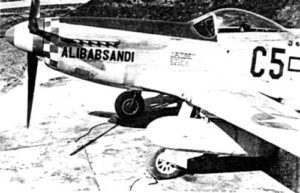
Gilman Weber’s P-51C, which he flew until war’s end. The odd name is a combination of his wife’s and daughter’s names.
THE YOXFORD BOYS were not involved in this bonanza, however, their escort mission being uneventful.
The Group also missed out on the “great jet massacre” on the 10th, when some 50 jets managed to down 10 bombers, losing 20 of their own. Most 8th AF fighter units had a share in this, but the 357th was busy at lower level, devastating aircraft on the ground near the bombers’ target airfield at Neuruppin. Twenty-three aircraft were claimed destroyed on this strafing attack, including two 262s by Colonel Dregne.
Enemy fighters of the conventional type had become very elusive, and only two were claimed during the month. Both of these were shot down on the 7th , when the mission leader reported that one of those shot down had been “working with a silver P-51 without squadron or nose markings, but carrying white stars on the side.” On this same mission, the leader reported: “Silver P-51 attack a bomber north of Brunswick about 1320 and was blown up by the bomber. One chute.”
Six pilots were lost during April, all but one as the result of light flak during airfield attacks. All five survived as POWs. The one fatality was Lt. Jacob Giel, whose P-51 was hit by a drop tank, and then spun into the channel, the last 357th operational fatality.
Contact with the jets finally came again on the 17th, in a violent combat in the Prague area. By this time the fields around this city were jammed with aircraft, and the skies above were crowed with U.S. and the RAF fighters and bombers. Colonel Dregne reported some 200 aircraft, including 12 Me262s dispersed on and around an airfield east of the city, and 150 more on Prague/Ruzne airfield. Two of the jets were destroyed by strafing by Lts. John Duncan and Anton Schoepke of the 362nd.
Seven 262s attempted to reach the bombers, who were striking a chemical plant at Ausig. These were deflected from the bombers, and all evaded except one.
Flight Officer James Steiger from 364 Squadron was the only one to score on this day. As can be seen by his encounter report, he got a very close-up look at an Me262. “I was flying Greenhouse blue four when we sighted an Me262 going 180 degrees to the bomber stream. We turned into the e/a as he turned into the bombers. The flight spread out and gave chase and I was on the extreme left. the e/a flew over Prague and I passed north of the town. At this time I sighted another 262 at 6,000 feet going to a northerly direction east of Prague. I tried to turn into the 262 but he turned inside me. I then pulled up into a wingover and rolled over onto his tail. As I closed I began firing at approximately 600 yards and continued right on up till approximately 15 yards away. At this time the e/a fell off on its left wing and dove straight into the ground and exploded.”
Steiger, who had exhibited exceptional alertness considering this was only his second combat mission, was to score no more victories in WWII, but he had joined an exclusive club with his one victory.
Lt. Col. Jack Hayes, bomber-pilot-turned-fighter-pilot, fired on another 262, but could claim only a damaged.
Sometime during April, date unknown, the 357th Group pilots had the rare opportunity to meet and talk to an Me262 pilot. The Monthly Intelligence Summary contained this item:
“The pilots and intelligence officers of the 357th Fighter Group were fortunate to receive a visit from Major Englander of the P/W & X Detachment during the month. The major stopped in on his way back to London from the 2nd Air Division. Accompanying Major Englander was one Hans Fay, onetime Luftwaffe pilot and until recently an acceptance pilot of the German Me262s.”
“An informal meeting of all pilots and I. O.s was called, Lt. Col. Evans presiding. the first past of the meeting was devoted to a discussion of tactics used against the Me262s by our pilots who had encountered them. After the critique Major Englander took over the meeting and gave the back ground on Hans Fay.”
“It seems that Fay, an anti-Nazi, had for some time considered joining the Allied fight against Hitler’s gang, but naturally enough, decided to wait until his hometown in Germany had been liberated by the Allies, thereby protecting his family from S.S. and Gestapo reprisals. When he learned that his home had been freed, he selected an Me262 fresh from the assembly line, took off, and a short time later landed safely in Allied territory surrendering his aircraft and himself to the American forces.”
“After this summation, Major Englander acted as interpreter for the many questions asked of Fay. All facets of the subject were covered in the question bee. Fay was very cooperative to everyone’s satisfaction.”
“Colonel Dregne, on behalf of all attending, expressed appreciation to Major Englander for the visit. this was the only operational unit in the 8th AF that had the benefit of the session with the major and Hans Fay.”
Fay was not only a valuable source of information, but he had brought the Allies their first flyable Me262, werke number 111 711, landing it at Frankfurt’s Rhein-Maine airdrome, on 30 March, and surrendering to U.S. troops.
The next day, the 18th , the Group went back to the hornet’s nest around Prague, losing only Lt. O. T. Ridley. Hit by ground fire, Lt. Ridely successfully bailed out, and began the long walk home. To his great good fortune he was able to contact the Czech underground, who hid, fed, and entertained him for the remaining few weeks of the war.
Major “Kit” Carson, who had destroyed a big Fw 200 on the ground the day before, was leading THE YOXFORD BOYS. From his superb book, Pursue and Destroy, we get his story of the mission of 18 April:
“My last engagement with the Me262s came on a mission specifically ordered to counterattack their operations at Prague on April 18, 1945. I was to lead the 357th Group with my squadron, the 362nd. It was customary to rotate the Group leadership i the air between five key officers: the Group Commander, the Group operations officer, and the three squadron commanders. It was my turn to be up front.”
“The mission objective was to cover the airdromes which the Me262s were using on the outskirts of Prague and destroy them on the ground or on takeoff, if our timing and intercepts were good. The dominant reason for our being there was that the bombers of the 8th were coming into the Prague area and would be vulnerable if the 262s were not kept on the ground or destroyed on takeoff. So the plan was to get 54 Mustangs of the 357th to Prague an hour before the heavies got into the area. The 262s did not have enough endurance to take off earlier. They would have to stay on the ground until the last possible minute to increase their time in contact with the bomber columns and thereby maximize their effectiveness. Furthermore, on takeoff and landing they were particularly vulnerable, as the early jets were forced to use all of the runway for both operations.”
“Prague was 600 miles away by the devious route that was plotted for us. To avoid revealing our target and intentions to the enemy we were going to make a couple of zig-zags in our course and go in on the deck to avoid radar detection. My problem then was to navigate 54 airplanes 600 miles down about 200 feet off the ground and improvise the tactics to keep the jets down after we got there. Between now and time over target gave me about four hours to think it over. We’d never tried this little gambit before so there was no precedent – we were going to make one. the one piece of concrete intelligence I had was that the flak at Prague would be brutal. they were absolutely correct.”
“The weather on the first half of the trip was typical of a gorgeous spring day. The sky was about 6/10s covered with cotton ball clouds, the visibility superb and everything was green on the earth below. It was so appealing one had the urge to bail out and float down to a green patch of grass and take a snooze in the spring sun.”
“Our first major checkpoint, Frankfurt, slid by underneath on schedule. It was in U.S. Army hands now. We turned to a heading of 090 and the visibility deteriorated badly due to a haze below cloud level. I had difficult seeing the squadrons to my left and right and also in seeing the terrain changes ahead of me, so I called the troops on the radio to tighten up the formation. ‘Judson Red Leader here to Cement and Greenhouse. Put your flights in trail and tighten it up. We’re losing contact.’ ‘Cement, Rogah-dodgah.’ ‘Red Leader again, we’ve got to pull up before target. At 12:50 we’ll go to 10,000.’ ‘Cement Rogah-dodgah.’ ‘Greenhouse, Rog-.’ Anonymous, ‘Tough titty, boss.'”
“Bunch of smart-alecks. Since we were hitting our checkpoints dead center and on time, I decided to keep the Group on the deck and pull up to 10,000 feet at 12:50, 10 minutes before we were due over Prague. We couldn’t fly the area because of the intense flak. I still hadn’t come up with a brilliant strategy. The flak was there and nothing would make it go away. Our assets were speed and maneuver but everyone knew that there was no point in cluttering up the radio with a lot of last-minute trivial advice.”
“At 12:50 we pulled up and the gods of war were on our side. At 1300 hours we came up dead center on Prague-Ruzyne airdrome and nothing was stirring. I asked my good friend, Major Don Bochkay, to take the 363rd and 364th squadrons east of Prague to cover the other airdromes there. Don was of Hungarian origin and never missed the chance for a little ethnic horseplay. ‘Red leader from Cement, I don’t like this town.. I think I’ll go on to Budapest.’ ‘What’s that?’ ‘Slivovitz and girls.’ A potent plum brandy and broads. He’d go for that. ‘Bochkay, pay attention before you get clobbered.’ “Rog-.”
“I kept my squadron at Ruyzne on the southwest side. We circled the field at 13,000 feet and all hell broke loose. the flak batteries opened up and the sky looked as if it had measles. we fell back a couple of miles to size up the situation and cruised around waiting for the next move. It soon came. Under cover of the flak umbrella the Me262 pilots cranked up and taxied one by one to the north end of the airdrome for takeoff. The moment of truth had arrived. They were going to try to punch their way through and get to the bombers anyhow. Our opposing strategy was now clear. My squadron would go down by flights of four, well spread to dilute the flak concentration on each of us as individual targets. As the first 262 started his takeoff roll we dropped our wing tanks and I started down with Red Flight from 13,000 with easy wingover and about 50 inches of mercury and 2,700 rpm. the Mustang would accelerate like a banshee going downhill. The 262 had his gear up and was going past the field boundary when we plowed through the intense light flak. As I came astern of him and leveled off at 400-plus, I firewalled it to hold my speed and centered the bull’s-eye of the optical sight on the fuselage and hit him with a two-second burst. My timing had been off. If I’d split from 13,000 feet about five seconds earlier I could have had all six fifties up his tail pipes. Even though I scored only a few strikes, it’s an even bet that he was too busy checking for leaks to make it to the bomber column. A solid hit can be just as good as a kill as a deterrent.”
“We turned back to Ruzne and found four jets over the field taking pot shots at some of our lads and baiting them into the flak-infested area over the field. I cut one off in a diving turn and gave him a long burst at about 400 yards hoping that he would go into an evasive turn where I could cut hi9m off and hit him again. He wouldn’t have any of it. Even though I got a few strikes he leveled off and took off for other parts.”
“Captain Chuck Weaver, my operations officer, did better. He nailed one that was attempting to land at Ruzyne and destroyed it. Don Bochkay, C. O. of the 363rd, shot one down that was taking off from an airdrome east of Prague where he was patrolling with the other two squadrons. He really didn’t want to go to Budapest after all.”
Carson was able to claim two as damaged. He had no further contact with the jets in the short time remaining. Today, 44 years later, he is most proud of his navigation that day. Leading 54 P-51s 600 miles across Europe “on the deck” and hitting the target on the button was a remarkable achievement.
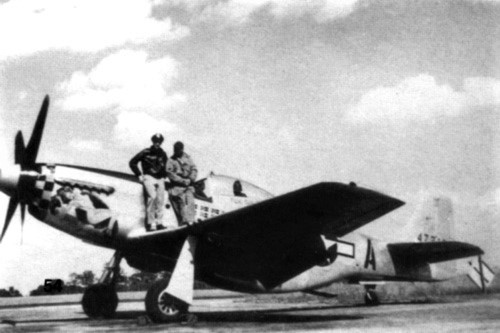
Chuck Weaver’s unnamed P-51 with the lovely nude. It was G4-A, 44-72199, and it survived the war as did Weaver.
The next day, the 19th of April, would be the big finale for THE YOXFORD BOYS, and its “big day” against the jets. A few more missions would follow, but they would be anticlimactic.
It was not a max effort day for 8th Air Force, 2nd Division standing down completely and 1st and 3rd Divisions providing less that 600 B-17s, all of which bombed marshalling yards and the other rail targets. 3rd Division lost five bombers, all to the jets.
With lt. Col. Jack Hayes leading A Group (one squadron), and Lt. Col. John Storch the other two squadrons, there was a total of 54 Mustangs at the 0924 takeoff. The mission report summaries the action: ” Four Me262s encountered in target area. Two made tail attacks in formation out of high cirrus cloud 26,000 feet on 4th box of bombers 1225 at target. Pursued, they pressed their attack through the formation, shooting one B-17 down. One flight gave chase, pursuing them from Dresden to Prague/Ruzyne A/D, where both were shot down at low level, one at 200 feet, by this flight. Jets did not take evasive action but relied on excess speed.”
Forty-four years later, Gilman Weber still has vivid memories of this encounter: “The bombers’ target was in the Dresden area. We were close to the target, above- to the east side of the bombers headed west when I spotted two 262s coming in on a box just ahead and to the right. They flashed under my nose from left to right. I called them out, dropped tanks, broke down and to the right after them. They went through and under the box of ’17s. I stayed just above the bombers. One 262 broke away to the right and turned back south and down the bomber stream. He turned right and made a pass at a straggler. His right turn on the straggler and his break away to the left gave me a chance to get close enough to get a shot that hit him in the cockpit area. It was a hell of a long shot even then. We continued in a shallow turn to about east and went down quite rapidly. He apparently tried to make it to the airfield at Prague. He bellied in west of the field about a mile. I pulled up to 3,000 feet above the ground level headed east and spotted another 262 in the pattern low on the south side of the field. I covered my wingman while he shot him down. He was low and slow and my wingman drove right up his rear. He caught fire, rolled over and the pilot bailed out. It was the first time I had ever seen a ribbon chute. I can still see it as though it had just happened. The irony is I’m not sure I can remember my wingman’s name. I think we called him ‘Mac’ for short.”
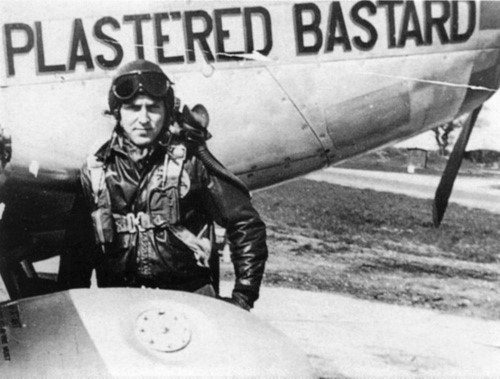
Captain Ivan McGuire, who shared Weber’s Me262 with his C5-J, 44-72056.
Captain Ivan McGuire, leading Greenhouse Blue flight, had also fired at this same 262, and credit for its destruction was shared by Weber and McGuire.
The pilot whose name Weber cannot now recall was 2nd Lt, James W, McMullen, who was flying only his second operational mission. It was his only victory of WWII.
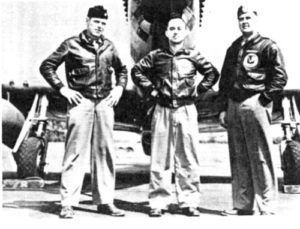
From 357th Group Headquarters, Lt. Col. Jack Hayes, Lt. Col. Andy Evans and Colonel Irwin Dregne, Group Commander. Hayes scored one against the jets and Dregne claimed two on the ground.
Lt. Col. Jack Hayes, ex-B-17 pilot, was about to get his revenge on the Luftwaffe fighters. Leading the 363rd Squadron, Hayes had swept the area ahead of the bombers, arriving over Prague-Ruzyne at 1150. Seeing no activity, he took the squadron up and soon observed 262s beginning to take off in elements of two. The mission report takes up the story:
” Squadron let down to 15,000 feet and after 16 became airborne, bounced them, destroying four and damaging three in the ensuing combat. Although bounced, the jets continued to take off. Colonel Hayes’ flight bounced one element as it took off. One turned left, and one to the right, pursued by elements of this flight. In the turn, Colonel Hayes got strikes on the 262 leader who turned left, hit the deck with full power and crossed the river at the southern outskirts of Prague. Intense and accurate flak from both sided of the river was encountered by Colonel Hayes, who had lost his wingman. The 262 went out of sight temporarily behind a tall building on the eastern shore of the river and as he pulled up over the building he saw the 262 hit the ground in a sharp turn to the right and the burning remains slid into a building.”
Three others from Hayes’ Cement squadron also scored. Lt, Carroll Ofsthun was flying his 67th, and next to last mission to complete his tour. He had taken off as a spare, but moved into Cement Red flight when No. 4 aborted. Now in the melee over Prague-Ruzyne he spotted a 262 pass under him. A fast wingover put him on the 262s tail, where he fired a short burst, getting many strikes in the cockpit area.
In a recent letter to the author, Ofsthun recalls: “I pulled up and came back over him and saw he had bellied into a field. I did not fire again – only shot my gun camera. As far as I was concerned, the plane was destroyed. Whether the pilot was killed or wounded, I do not know.”
Long-range shooting, as was often the case with the jets, was required for Lt. Paul Bowles to get his 262. Firing at about 1,000 yards, he got a few strikes, the jet then making a turn to the left, heading back over the airfield. Anticipating the jet’s course and now with an altitude advantage, Bowles and his wingman Gifford Miller closed the range to some 600 yards, getting more hits, now at treetop level. It was enough as the 262 hit the ground and exploded. Bowles says: “I then returned to the spot and took pictures of the smoke and fire. the plane was scattered all over hell’s half acre and I hardly believe the pilot got out.”
The sixth man to score on the 19th was Captain Robert Fifeld, who already had an Me262 on his victory. list and was about to become one of only five of the 8th Air Force who had claimed a double on jets. His encounter report is highly interesting, and we will quote it in full to close out the action of the 19th of April, and of the 357th Fighter Group’s war with jets.
“I was leading Cement White flight when we arrived at Prague. Some jets were called in while taking off. I watched two elements take off and saw two more ships go down the runway in formation. I couldn’t wee anyone taxiing on the field so called, ‘Cement White flight dropping tanks.’ We were at 16,000 feet. There was no reply so I dropped and started down on a jet about three miles from the field. I started firing when I got in range and continued until I overran him. I pulled up slightly and then dropped back down on him, and shot some pieces off. He started burning in the left jet unit, pulled up and did a half-roll and went straight in and exploded. I was then at about 2,000 feet. I couldn’t see any of my flight so I started climbing and said I would meet them over the field.”
“I got up to 10,000 or 12,000 feet when I saw another jet below me. I went down on him, got some hits, but I was also hit by light flak so I hit the deck and let him go. I saw two squadrons of bombers with re-tipped rudders coming in from Prague. There were some stragglers and I thought I saw one of them go down in flames. I couldn’t see any escort for them and figured they were being hit so I headed for them alone and called my group leader about it. I didn’t hear any answer from hi but Lt. Zarnke called and said he was at 3 o’clock to me. I saw a jet coming up behind one of the stragglers below me. I went down on him and he headed east after shooting at the bomber which he did not get. He started a turn to the left and I cut him off and gained slightly on him. He headed north. I figured he would try to get back to Prague, so I just kept him in sight and got between him and Prague. I positioned Lt. Zarnke between me and Prague so he could come down if I missed. The jet made another turn toward us and Prague. I shot with only two guns and missed. I told Lt. Zarnke to dive between me and a small town since he couldn’t see the jet. He met the jet over this town which was about 20 miles east of Prague. I saw him get hits, but our engines couldn’t take it any longer, so we throttled back and set course for home. I claim one Me262 destroyed and one Me262 damaged. Ammunition expended: 1,600 rounds.”
With a little more luck, Robert Fifield could have been the only man to destroy three jets. Two weeks later, on the 3rd of May, Fifield’s luck ran out permanently. With the war over, he was dogfighting two RAF Mustangs, and was killed when his P-51 crashed near home base at Leiston.
A total of six 262s had been shot down on the 19th, with another five claimed as damaged. These six brought the total air claims to 18.5 jet aircraft destroyed, all Me262s, but the 357th. In addition, four more were claimed destroyed on the ground. Fourteen were listed as damaged in air combat, and there was a credit fro a probable. All of the 18.5 air victories are confirmed, and are on the official USAF victory credits list for WWII.
Although most 8th Air Force Fighter Groups did score against the jets, only three approached the 357th’s 18.5 – the 55th with 17, and the 78th and 339th with 15 each.
The only known 357 loss to the jets was Lt. Warren Corwin, and P-51B, 43-12227. Although some mystery shrouds Corwin’s death, apparantly he was shot down by Franz Schall on 8 November 1944, moments before Schall was shot down by James Kenney of the 362nd Squadron.
Of the five 8th AF pilots who scored doubles against jets, two of the five were members of the 357th. These were Major Don Bochkay, and Captain Robert Fifield, both of the 363rd Squadron.
Now it was over, THE YOXFORD BOYS would fly four more missions, but they would fight no more. The very last mission – four Mustangs led by Ed Hyman, was, appropriately enough, an escort of an Air Sea Rescue Vickers Warwick, on an unsuccessful search for an airman down at sea.
The P-51 would, in a few short years, fight again in another war, but it was no longer the star performer. That place in the arena of air combat had been taken by the descendants of their late opponent – the mighty Messerschmitt 262.
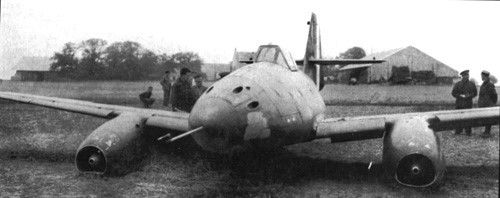
Summary and Conclusions
One of the most vivid impressions gained while researching this article was that, despite the technical advancements of the Me262, with a clear speed advantage, it was more often than not the hunted instead of the hunter. From reading the mission and encounter reports of the 357th Group, and of other groups, it is clear that the 262s were actively sought out, and were attacked without hesitation if the circumstances allowed.
One circumstance only resulted in hesitation to attack, and this was if the jets were on, or at low altitude over, their own bases. this prudent hesitation, of course, was caused by the well-founded fear of Luftwaffe flak, which was usually deadly. Even then many Allied fighters bored in, in the teeth of the guns, in an attempt to destroy them. This is well illustrated in Pierre Closterman’s magnificent book, The Big Show. Here he narrates the efforts of the RAF Tempest wing which he led (as a French Air Force Second Lieutenant) in the last days of the war. Often under orders to attack the jet bases, they did so, suffering severe losses for little gain.
It is also clear that the jets were not a major threat to Allied fighters if they were spotted in time. If not spotted in time to evade, the 262s heavy armament could turn a Mustang or Spitfire into junk with one short burst. While the 262 could usually evade with its superior speed, Allied fighters could generally evade with their superior maneuverability. For the bombers, of course, the situation was reversed. With their great speed and heavy guns, the jets were a very serious threat to all Allied bombers. Nevertheless, some of the jets were shot down by bomber gunners.
It should also be said that the pilots of the Me262s, pioneers in a new age, seemed to have used their weapon well. Even though always outnumbered, and often with scant training, they lived up to the reputation of courage and aggressiveness shown by Luftwaffe aircrews throughout WWII.
Wars, and other human events, are influenced not only by chance, but also by major and often minor decisions, by both major and minor people. Did the decision by Hitler, and possibly others down the chain of command, that delayed the operational debut of the 262, have any effect on the war’s outcome? Many writers have pondered if the 262 had debuted earlier. However, it is interesting to note that Dr. Williamson Murray, in his superb book, Strategy for Defeat, the Luftwaffe, 1933-1945, demonstrates that the German Air Force had already irrevocably lost air superiority over the continent by the time 262 production was getting under way. German fighter units had been savaged by Allied escort fighters, and with the heavy loss of Luftwaffe “old hands,” he concludes that an effective 262 force could not have been brought together.
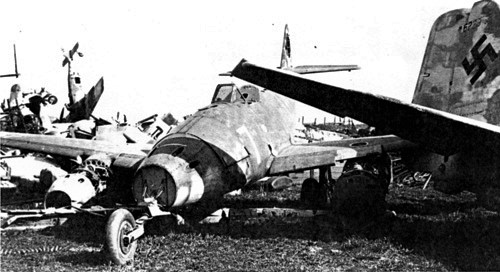
A typical end for those Me262s which survived the violent combat of the last six months of the war. This forlorn, but generally intact 262 was photographed at Neubiberg Air Base near Munich in the fall of 1945.
357th Fighter Group Me 262 Victory Credits:
1. Captain Charles E. Yeager, 6 November 1944.
2. 1st Lt. Edward R. Haydon, 8 November 1944; 1/2 credit share with 20th Group.
3. 1st Lt. James W. Kenney, 8 November 1944; Franz Schall, bailed out.
4. Captain Robert P. Winks, 15 January 1945.
5. 1st Lt. Dale Karger, 20 January 1945.
6. 1st Lt. Roland K. Wright, 20 january 1945.
7. Major Donald H. Bochkay, 9 February 1945.
8. 1st Lt. Johnnie L. Carter, 9 February 1945.
9. Major Robert W. Foy, 19 March 1945.
10. Captain Robert S. Fifield, 19 March 1945.
11. F/O James A. Steiger, 17 April 1945.
12. Captain Charles E. Weaver, 18 April 1945.
13. Major Donald H. Bochkay, 18 April 1945.
14. Captain Robert S. Fifield, 19 April 1945.
15. 1st Lt. Paul N. Bowles, 19 April 1945.
16. 1st Lt. Carroll Ofsthun, 19 April 1945.
17. 1st Lt. James P. McMullen, 19 April 1945.
18. 1st Lt. Gilman L. Weber, shared with Captain Ivan I. McGuire, 19 April 1945.
19. Lt Col. Jack Hayes, 19 April 1945.
Destroyed Credits, On Ground:
1. Colonel Irwin H. Dregne, 10 April 1945, two destroyed.
2. 1st Lt. Anton Schoepke, 17 April 1945, one destroyed.
3. 1st Lt. Andy Duncan, 17 April 1945, one destroyed.
Probably Destroyed, Air:
1. Major Robert W. Foy, 9 February 1945.